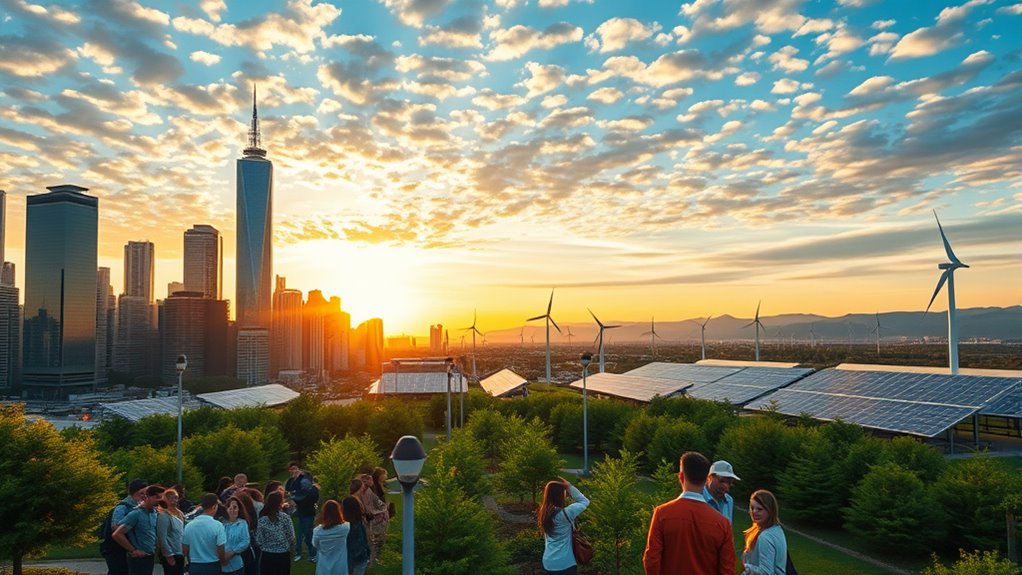

Facing global challenges like climate change, inequality, and economic instability can feel overwhelming, but hopeful action is possible through innovation and resilience. You can support community-led projects, advocate for policies that prioritize sustainability, and embrace creative solutions to societal problems. Combining efforts in social innovation and climate resilience helps communities adapt and thrive. By taking tangible steps, you contribute to meaningful change — and there’s much more to discover about how hope fuels progress.

Turn your quiet moments into listening time
- Thousands of audiobooks, podcasts and originals
- Listen on your phone, tablet or Echo — also offline
- Cancel anytime
Key Takeaways
- Innovative solutions and resilience efforts address climate change, economic instability, and social inequalities.
- Building climate resilience involves adapting infrastructure and community practices for environmental shocks.
- Social innovation fosters collaboration and community-led projects to solve persistent social issues effectively.
- Combining climate resilience with social innovation creates sustainable, empowered communities prepared for future challenges.
- Hopeful action includes supporting policies, initiatives, and innovations that promote resilience and positive societal change.

Have you ever wondered how we can confront the world’s biggest challenges and still find hope? It’s a question many of us grapple with as we face issues like climate change, economic instability, and social inequalities. The good news is that solutions are emerging, often driven by innovative approaches that blend resilience and creativity. One of the most promising ideas is building climate resilience—adapting communities so they can withstand and recover from environmental shocks. When you focus on climate resilience, you’re not just reacting to disasters; you’re proactively designing systems and infrastructure that can endure extreme weather, rising sea levels, and other climate-related threats. This involves integrating sustainable practices into urban planning, agriculture, and energy use. It’s about making communities more self-sufficient and flexible, so they don’t crumble under pressure but instead bounce back stronger.
But resilience alone isn’t enough. Social innovation plays a critical role in transforming the way we solve problems. It’s about finding new, effective ways to address long-standing social issues—whether that’s poverty, access to education, or healthcare. Social innovation encourages collaboration across sectors, uniting governments, businesses, nonprofits, and citizens to develop creative solutions. Think of community-led projects that empower local populations or tech-driven initiatives that increase access to crucial resources. These innovations are often simple in concept but revolutionary in impact, showing that change doesn’t have to come from top-down policies alone. They foster a sense of hope and collective agency, reminding us that even small actions can ripple outward and create broader societal shifts.
When you combine climate resilience with social innovation, you’re working toward a future where communities are not only prepared for environmental challenges but also equipped to thrive despite them. For example, adaptive farming techniques can help food systems endure droughts, while social enterprises can create employment opportunities in underserved areas. Additionally, understanding and implementing raw food diets can contribute to better health and sustainability in communities, exemplifying how individual choices can support broader resilience and well-being. This integrated approach demonstrates that hope isn’t just wishful thinking; it’s built through tangible efforts to create more resilient, inclusive societies. It’s about recognizing that the biggest challenges require us to think differently and act creatively. By supporting innovative projects, advocating for policies that prioritize resilience, and engaging in community initiatives, you contribute to a global movement rooted in hope, progress, and the belief that change is possible—even in the face of adversity.
climate resilience infrastructure kit
As an affiliate, we earn on qualifying purchases.
As an affiliate, we earn on qualifying purchases.
Frequently Asked Questions
How Can Individuals Make a Measurable Impact on Global Challenges?
You can make a measurable impact by embracing individual activism and supporting community initiatives. Start by educating yourself and spreading awareness, then take tangible actions like volunteering, donating, or advocating for change. Your voice can influence others, creating a ripple effect. Participating in local projects amplifies your impact, demonstrating that collective efforts begin with individual choices. Every small step contributes to addressing global challenges and fostering a more sustainable future.
What Innovative Technologies Are Emerging to Address Climate Change?
You’re on the brink of a revolution in combating climate change. Emerging technologies like advanced renewable energy systems harness the sun and wind more efficiently, transforming our power sources. Meanwhile, cutting-edge carbon capture techniques trap greenhouse gases directly from the atmosphere or emissions, turning a threat into a tool for change. These innovations promise a cleaner future, and your support accelerates their development, making a real difference in the fight against climate change.
How Do Cultural Differences Influence Solutions to Global Problems?
You see that cultural perceptions and value systems shape how solutions are approached and accepted worldwide. When you consider different cultures, you realize they influence attitudes toward conservation, technology, and collaboration. You can adapt strategies by respecting these differences, ensuring initiatives resonate locally. Recognizing diverse perspectives helps you develop more effective, inclusive solutions, fostering global cooperation. Ultimately, understanding cultural influences empowers you to create impactful, sustainable actions for worldwide problems.
What Role Do Governments Play in Fostering Hopeful Action?
Governments play a vital role in fostering hopeful action by promoting policy innovation and leadership development. You can support this by advocating for policies that address global issues and encouraging leaders to inspire positive change. When governments prioritize innovative solutions and cultivate strong leaders, they create an environment where hope and action thrive. Your involvement helps hold them accountable and drives progress toward a better future.
How Can Education Promote Long-Term Sustainable Change?
You can promote long-term sustainable change through education by supporting educational reform that emphasizes critical thinking, environmental awareness, and social responsibility. Encouraging lifelong learning helps individuals adapt to evolving challenges and stay engaged in creating positive impact. By fostering inclusive, innovative learning environments, you empower people to develop solutions that address global issues, ensuring lasting progress and hope for future generations.
Conclusion
While the road ahead may seem dotted with subtle hurdles, remember that your collective efforts can gently steer us toward brighter days. Every small step you take, like a whisper of change, nurtures hope in a world enthusiastic for renewal. Though challenges may softly linger, your resilience and kindness act as guiding stars, quietly inspiring a future where harmony and progress bloom softly but surely. Together, you hold the power to craft a better tomorrow.
Halloween Picks
halloween
As an affiliate, we earn on qualifying purchases.