
Opportunity isn’t distributed equally because societal structures, policies, and resource access favor those with privilege while limiting others’ chances. Coming from resource-rich backgrounds gives you advantages, like better education and networks, while scarcity for others creates barriers that are hard to overcome. Systemic issues and inequality reinforce these gaps across generations. If you want to understand how these barriers are built and what can be done, there’s more to uncover.

Turn your quiet moments into listening time
- Thousands of audiobooks, podcasts and originals
- Listen on your phone, tablet or Echo — also offline
- Cancel anytime
Key Takeaways
- Societal structures and policies favor the privileged, leading to unequal access to resources and opportunities.
- Wealth, race, and geography significantly influence individuals’ chances for social mobility.
- Underfunded communities and systemic barriers limit opportunities for marginalized groups.
- Intergenerational disadvantages perpetuate resource scarcity and reduce upward mobility.
- Structural inequalities require systemic reforms to create fairer, more equal opportunity distribution.
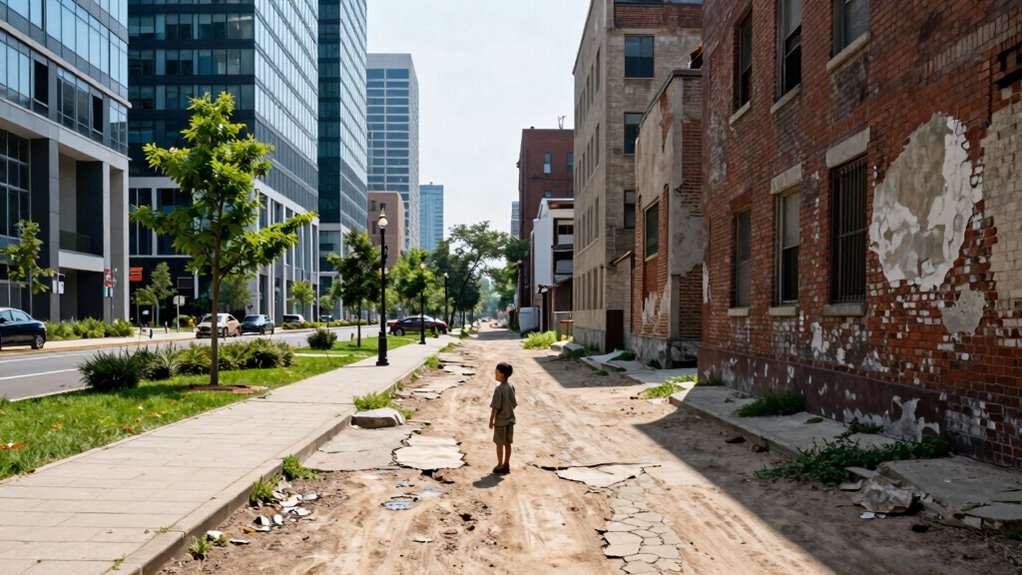
Have you ever wondered why some people seem to have a head start in life while others struggle to catch up? The answer often lies in how opportunity is distributed, or more accurately, how it isn’t. Access to resources plays a vital role here. When you come from a background with ample educational tools, good healthcare, stable housing, and supportive networks, you’re naturally positioned for greater success. Conversely, if those resources are scarce or unreliable, your chances of advancing diminish. This uneven access creates a cycle where privilege breeds more opportunity, and disadvantage compounds over generations.
Social mobility—the ability to move upward in society—is directly impacted by this unequal distribution. If you’re born into a wealthier family, you’re more likely to attend better schools, find mentorship, and secure connections that open doors to lucrative careers. On the other hand, if you’re born into poverty, those opportunities are often out of reach. It’s not simply about individual effort; it’s about systemic barriers that prevent many from breaking free from their circumstances. When access to resources is limited, social mobility stalls, making it harder for people to improve their lives regardless of their talent or ambition.
This inequality isn’t accidental. Policies and societal structures tend to favor those already in advantaged positions. Wealth, race, geography—all influence access to opportunities. For example, neighborhoods with underfunded schools or fewer job prospects limit children’s future options, trapping them in cycles of poverty. It’s not fair, and it’s not just a matter of personal choice. When opportunity isn’t evenly distributed, some people get a clear advantage from the start, while others have to work twice as hard just to keep pace.
The consequences ripple beyond individual success. Societies with significant opportunity gaps often face increased inequality, social tension, and reduced overall growth. When only a select few can access the resources necessary for advancement, society’s potential diminishes. You might see this in the widening wealth gap or in the persistent barriers faced by marginalized groups. Addressing these disparities requires more than individual effort; it demands systemic change to create fairer access to resources and real pathways for social mobility. Only then can opportunity be truly shared, giving everyone a fair shot at a better future.
educational resources for underserved communities
As an affiliate, we earn on qualifying purchases.
As an affiliate, we earn on qualifying purchases.
Frequently Asked Questions
How Does Opportunity Inequality Affect Economic Growth?
Opportunity inequality hampers your economic growth by limiting social mobility and perpetuating historical barriers. When certain groups face restricted access, your economy can’t fully harness diverse talents and innovative ideas. This creates a less dynamic workforce, reduces productivity, and slows overall progress. Addressing these disparities release potential, enabling everyone to contribute meaningfully, which in turn fuels sustainable economic growth and benefits society as a whole.
What Role Do Government Policies Play in Opportunity Distribution?
Government policies are the architects of social mobility, shaping the landscape where opportunity blooms or withers. When policies create barriers—like restrictive regulations or unequal access—they block pathways for many, stifling potential. Conversely, inclusive policies act as bridges, connecting individuals to resources and chances for success. Your role, through advocacy or awareness, can influence these policies, turning the tide toward a fairer distribution of opportunity.
Can Technology Help Reduce Opportunity Disparities?
Technology can help reduce opportunity disparities by bridging the Digital Divide and breaking down Access Barriers. You can leverage internet programs and affordable devices to reach underserved communities, providing equal access to education, job opportunities, and resources. By promoting digital literacy and infrastructure, you empower more people to participate fully in the modern economy. While technology isn’t a complete solution, it’s an essential tool in creating a more equitable distribution of opportunities.
How Do Cultural Factors Influence Opportunity Inequality?
You step into a world painted with vibrant hues of cultural biases and social norms, which shape opportunities like an unseen maze. These influences act as gatekeepers, subtly guiding or blocking paths based on ethnicity, gender, or background. Cultural biases reinforce stereotypes, while social norms establish unwritten rules that can limit acceptance or access. Together, they create invisible barriers, making it harder for some to find the chances others take for granted.
What Are the Long-Term Societal Impacts of Unequal Opportunities?
You might find that unequal opportunities hinder educational access and limit social mobility, leading to entrenched disparities over time. When some groups lack resources, their chances for success diminish, creating a cycle of poverty and inequality. This long-term societal impact reduces overall growth, fosters division, and stifles innovation. If these disparities persist, future generations may face fewer opportunities, perpetuating inequality and preventing a fair, thriving society.
Conclusion
So, next time you see someone struggling to access opportunities, ask yourself: what if everyone had the same chance to succeed? The reality is, opportunity isn’t distributed equally, and that imbalance shapes lives and futures. You have the power to recognize this inequality and advocate for change. Isn’t it your responsibility to help create a world where opportunity isn’t just a privilege for some, but a right for all?
Fall Picks
fall essentials
As an affiliate, we earn on qualifying purchases.