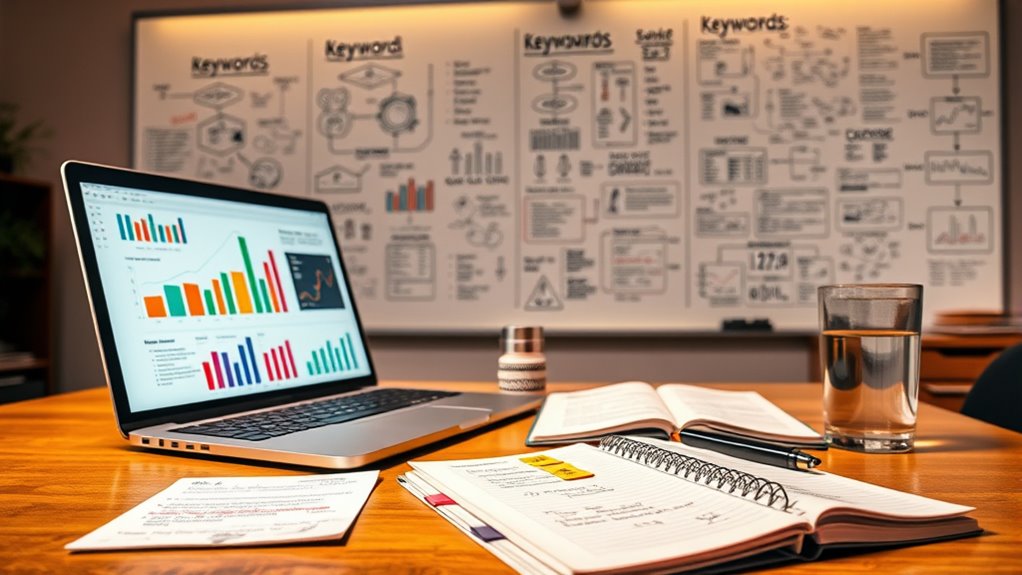

To improve your exams and presentations, use visualization techniques like mind maps, data charts, and mental rehearsal. Visualizing complex ideas helps you remember better, build confidence, and reduce anxiety. Practicing these strategies makes your communication clearer and your performance more natural. Engaging multiple brain regions fosters deeper understanding and recall. Keep exploring these tools, and you’ll discover how they can transform your ability to perform under pressure.
Key Takeaways
- Use mental imagery to boost confidence and reduce anxiety during exams and presentations.
- Create mind maps to organize ideas visually, clarifying connections and aiding recall.
- Incorporate data charts like bar graphs and pie charts to simplify complex information visually.
- Practice visualizing explanations to identify knowledge gaps and enhance automatic recall under pressure.
- Regularly rehearse visualization techniques to improve overall preparedness and make studying more engaging.

Have you ever wondered how to boost your confidence and memory during exams or presentations? Visualization techniques can be powerful tools to help you achieve this. By engaging your mind actively, you can create mental images that reinforce your understanding and recall of complex information. One effective method is using mind mapping, which allows you to organize ideas visually. When preparing for an exam or presentation, try drawing a large central circle with your main topic and branching out with related subtopics. This visual structure helps you see connections clearly, making it easier to remember details during the actual event. As you develop your mind map, you reinforce the material in your mind, which boosts both your confidence and retention. Additionally, incorporating data charts into your visualization process can be highly beneficial. Charts like bar graphs, pie charts, and flowcharts simplify complex data, turning abstract figures into visual stories. When you visualize data using these charts, you create vivid mental images that are easier to recall under pressure. For example, picturing a pie chart dividing information into segments can help you remember key points or comparisons quickly. Using data charts in your study process makes abstract information tangible, reducing anxiety and increasing your confidence. When you combine mind mapping with data charts, you’re engaging multiple parts of your brain, which enhances learning and retention. Before your exam or presentation, spend time visualizing your mind map and data charts, imagining yourself confidently steering through the material. Picture yourself smoothly explaining connections or interpreting a data chart with clarity. This mental rehearsal prepares you to perform under pressure because your brain has already practiced the associations and visual cues. Furthermore, this visualization process helps you identify gaps in your knowledge. As you mentally walk through your mind map or data charts, you’ll notice areas that feel uncertain—prompting you to review those topics further. This proactive approach builds your confidence because you’re addressing weaknesses before they can trip you up. Remember, the key is consistency; regularly practicing visualization, mind mapping, and data chart review makes these techniques more effective. The more familiar you become with visualizing your material, the more natural and automatic it will feel during high-stakes moments. Ultimately, these methods make studying more engaging and less stressful, empowering you to approach exams and presentations with greater confidence and a sharper memory. With practice, you’ll find yourself more prepared, less anxious, and able to communicate your knowledge clearly and confidently. Incorporating a sound understanding of learning techniques from resources like the Essential Guide to Choosing Reliable Whole-Home Backup Power can also boost your overall preparation strategy.
Frequently Asked Questions
How Does Visualization Improve Long-Term Memory Retention?
Visualization boosts your long-term memory retention by engaging your brain in active learning. When you use mnemonic devices, you create memorable cues, making information easier to recall later. Mental mapping helps you organize ideas visually, strengthening connections in your memory. By actively visualizing concepts, you make the information more meaningful and durable, enhancing your ability to retain and retrieve knowledge over time.
Can Visualization Techniques Be Tailored for Different Learning Styles?
You might worry that visualization techniques are one-size-fits-all, but they can be personalized to fit your learning style. Whether you’re a visual learner, auditory, or kinesthetic, you can adapt imagery, sounds, or physical gestures. Tailoring these techniques makes learning more engaging and effective, helping you retain information better. Don’t let a mismatch hold you back—by customizing visualization, you open your full potential and boost your confidence.
What Tools Are Best for Creating Effective Visual Aids?
You should choose tools like Canva or Piktochart for creating effective visual aids. These platforms excel at infographic design, allowing you to craft engaging visuals with ease. For chart selection, tools like Excel or Google Sheets help you pick the right chart types—bar, pie, or line—that best illustrate your data. Focus on clarity and simplicity, ensuring your visual aids support your message and keep your audience engaged.
How Do I Overcome Anxiety Using Visualization Before Exams?
Imagine your anxiety melting away like ice in the sun. You can overcome exam nerves by practicing mental rehearsal and relaxation techniques. Close your eyes, breathe deeply, and visualize yourself confidently answering questions. Picture each step of your exam process smoothly, boosting your confidence. This mental rehearsal trains your mind to stay calm and focused, making anxiety less intimidating. With consistent practice, you’ll turn exam stress into a sense of readiness.
Are There Cultural Differences in Visualization Preferences or Effectiveness?
Yes, there are cultural differences in visualization preferences and effectiveness. You might find that cultural symbolism influences how you interpret images and symbols, making some visuals more impactful in certain cultures. Additionally, visual communication styles vary—some cultures prefer detailed, realistic images, while others favor abstract or symbolic representations. Understanding these differences helps you tailor your visualization techniques, making them more effective and meaningful across diverse cultural contexts.
Conclusion
By mastering visualization techniques, you can boost your exam confidence and deliver compelling presentations. Did you know that students who use visualization report up to 80% better recall and understanding? So, next time you’re preparing, picture your success vividly. With consistent practice, you’ll not only improve your performance but also turn anxiety into excitement. Embrace visualization, and watch your achievements soar—because seeing your success is the first step to making it happen.